America's Teacher Shortage Has Become a Full-Blown Emergency
When the school year began last September, Jefferson County Public Schools in Kentucky had 437 unfilled teaching positions. By October, the district had resorted to placing uncertified substitutes in long-term classroom roles and consolidating classes so that some teachers were responsible for 40 or more students at a time.
Jefferson County is not an outlier. It is the norm.
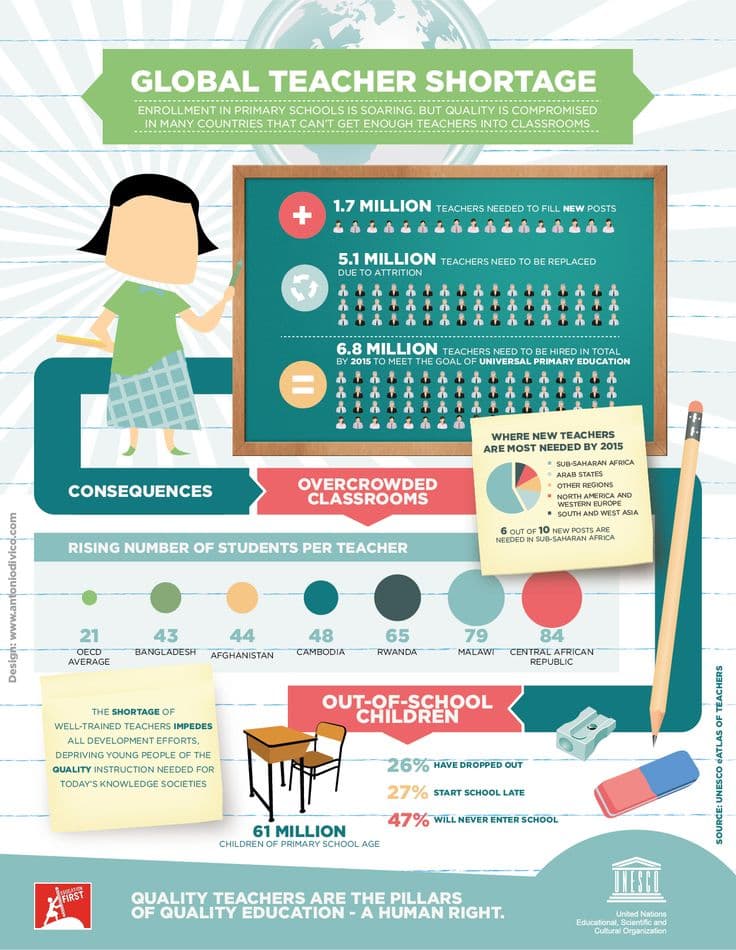
Across the United States, the teacher shortage that education researchers have warned about for years has metastasized into something that looks and feels like an emergency. The Learning Policy Institute estimates that the national shortfall now exceeds 300,000 positions, a figure that has roughly doubled since 2019.
The Numbers Tell a Grim Story
According to data from the Bureau of Labor Statistics, the number of people employed as K-12 teachers has dropped by nearly 8 percent since the pandemic, even as student enrollment has stabilized. Education degree enrollments at universities have fallen by 35 percent over the past decade, meaning the pipeline of new teachers is shrinking at the very moment demand is surging.
The shortages are most acute in special education, mathematics, science, and bilingual instruction -- precisely the areas where expertise is hardest to replace with a warm body and a textbook. Rural districts and high-poverty urban schools are hit hardest, deepening inequities that were already severe.
"We are asking the least-resourced communities to absorb the worst consequences of a systemic failure," said Becky Pringle, president of the National Education Association.
Why Teachers Are Leaving
The reasons behind the exodus are well documented and mutually reinforcing. Compensation remains stubbornly low. The average starting salary for a teacher in the United States is roughly $42,000, and in some states it falls below $36,000 -- figures that are increasingly uncompetitive with other professions requiring a bachelor's degree.
But money is only part of the equation. Surveys consistently show that burnout, lack of administrative support, and the politicization of curriculum are driving experienced educators out of the profession at rates not seen in modern history.
The culture wars over what can and cannot be taught have taken a particular toll. Teachers in several states report self-censoring lessons on history, race, and gender out of fear of parental complaints or legal repercussions under recently enacted legislation. Many describe an atmosphere of suspicion that is fundamentally incompatible with effective teaching.
"I did not leave because of the students," said Maria Gonzalez, a former high school English teacher in Texas who resigned after 14 years. "I left because I was told I could not teach honestly, and then I was blamed when test scores dropped."
Emergency Measures and Their Limits
States have responded with a grab bag of emergency measures. At least 18 states have lowered certification requirements or created alternative pathways that allow individuals without education degrees to enter classrooms after abbreviated training programs. Several have raised starting salaries, though often by amounts that fail to keep pace with inflation.
Arizona made national headlines last year by launching a program that allows college students to begin teaching as paid interns during their junior year. Florida expanded its military-to-classroom pipeline, permitting veterans with no teaching background to lead classes after a short orientation.
Critics argue that these approaches prioritize filling seats over maintaining quality. "Lowering the bar is not a strategy. It is a concession that we have given up on doing this right," said Linda Darling-Hammond, president of the California State Board of Education.
What Would Actually Work
Education researchers point to a handful of interventions that have shown results in states and districts willing to invest. Competitive salary schedules that bring teacher pay in line with other college-educated professions consistently reduce attrition. Structured mentoring programs for early-career teachers cut first-year dropout rates by as much as 50 percent. And reducing class sizes and non-teaching duties gives educators the bandwidth to focus on instruction.
Some districts have seen success with grow-your-own programs that recruit teaching candidates from within the community, often targeting paraprofessionals and teaching assistants who already know the schools and the students.
The Stakes Are Enormous
The consequences of the shortage extend far beyond inconvenience. Research consistently links teacher quality to student outcomes, and students taught by uncertified or underprepared instructors show measurably lower achievement gains. The ripple effects -- lower college enrollment, reduced lifetime earnings, wider achievement gaps -- compound over years and generations.
For a country that routinely declares education a national priority, the gap between rhetoric and reality has never been wider. The classrooms are there. The students are there. The teachers, increasingly, are not.